 Trace. Question. Emerge.
The Connector That Became the Floor
Try to think about a problem without using language. Pick anything — a project at work, a worry about someone you love, what you want from the next year. Watch what happens when you reach for the thought.
The thought arrives in words. Sometimes pictures. Sometimes a felt sense underneath the words. But the moment you try to examine the thought — turn it around, ask whether it is right, decide what to do — language shows up. The voice in your head. The categories that cut the situation into parts: project, deadline, manager. The story the parts hang on.
The medium is so close to the looking that it almost vanishes. That nearness is the thing this piece is about.
Language is one of the strangest emergences in the universe’s history. Most things that emerge stay in their lane. Gravity attracts. DNA replicates. Photosynthesis converts sunlight to sugar. They each do one job, and they keep doing it. Language is different. It started as a way for humans to coordinate with each other and ended up as the substance through which we see almost everything else.
This article is about that move — what it means for a connector between minds to become the medium we use to navigate the rest of reality.
The stack, briefly
The Arena walks through reality as fifteen substrate levels, E0 through E14. Below E8, each level introduces a new kind of material — fields, particles, atoms, molecules, cells, organisms, ecosystems. At E8, the stack does something new. It produces a substrate that can model itself. Minds.
From E9 onward, the levels stop introducing new material. They bind the same material — minds — into progressively larger and more durable patterns: cultures, institutions, organizations, states, civilizations. Same stuff. Different binding.
The question this piece sits inside: what carries the load across that boundary?
Once minds exist, what lets them coordinate into something larger than themselves? And once those larger patterns exist, what is the medium we use to see them, talk about them, work inside them?
one of that medium is language, one of the most important connectors. And the strange thing about language is that it does both jobs at once.
Connectors, and a different kind of connector
Every emergence in the stack runs on connectors. Atoms hold to each other through chemical bonds. Cells exchange signals across membranes. Synapses fire action potentials between neurons. Ecosystems are held together by predator-prey loops, mycorrhizal networks, nutrient cycles, gene flow.
These are great connectors. Each one carries information specific to its level — chemical, electrical, ecological, dynamics. Each makes its level’s emergence possible. Without bonds, no molecules. Without synapses, no nervous systems. Without ecological loops, no ecosystems.
Language sits next to all of these and does something they don’t.
Other connectors carry one kind of signal between two specific things. Language carries all the others. A predator-prey relationship can be talked about, named, taught, written down, compared with predator-prey relationships in other ecosystems, modeled in mathematics, argued over at a conference. The original connector is still doing its work in the world. But there is now a second layer of connection — language — that links the original connector to every other connector a mind has ever encountered.
Language is a meta-connector. It does not replace the great connectors below it. It does not outrank them. It connects to them, links them to each other, and makes them available as objects we can hold in mind together.
This is what makes it different from everything else at E8. Not that it is the only connector between minds — gesture, eye contact, music, ritual, shared work all do real work too — but that it is the connector through which minds reach into every other layer of reality and bring something back.
What this means for the upper levels
Above E8, the stack stops adding new physical material. The new floors are made of minds bound differently. Something has to do that binding, and language does most of it.
Culture (E9) is held together by many things — shared bodies, shared places, shared work, shared rhythms, shared rituals. Language is part of culture, deeply, but culture is not made of language any more than a body is made of blood. Language is the part of culture that lets it be carried — the part that survives a generation dying, or a community moving, or a story being told to someone who wasn’t there. Without language a culture exists; without language a culture’s addres in shared minds become difficult to reach,
Institutions (E10) are culture patterns that have been written down, named, given enforcement. The writing is language. The names are language. The enforcement is coordinated through linguistic specifications that say what counts as a violation and what happens when one occurs. An institution without language is not a quieter institution. It is something else.
Organizations, states, civilizations — each runs on its own coordination mechanisms, its own bodies, its own places, its own pressures. Each is real in ways that have nothing to do with language. But each becomes legible, transmissible, composable through language.
The upper levels are not made of language. They are real patterns in the world — the reality, patterns of bodies, places, resources, power, time. What language does is give us a map of them. The map is how we see them, locate them in our mind, name them, argue about them, change them. Remove language and E9 through E14 do not vanish — but the map we use to navigate them does, including this piece you are reading right now.
Language is one of the most common, lowest-friction ways of emergences to become thinkable to the minds inside them. There are other ways — embodied practice, ritual, music, direct work — but language is the one that scales, the one that travels, the one most readily available the moment a mind reaches for the situation.
What language does inside a single mind
Language is also a tool inside the mind that uses it. It has occupied substantial workspace and help link several aspects.
The body sends signals regardless of vocabulary. Pattern recognition fires before naming. The click of recognition — all of it runs underneath, with or without language.
What runs because of language is the part of mental life that holds together over time. The voice that represents you to you. The story you tell yourself about what you are for. The capacity to hold a value as a stable object you can defend, refine, examine. Damage the language that holds these and a major pillar of the structure weakens or breaks. Meaning crises, mid-life crises, conversions — all show up as language events. The vocabulary that no longer fits. The new words that suddenly do.
Language has not replaced the older inhabitants of the mind. It has occupied the workspace so thoroughly that they are harder to access without effort. Contemplative traditions developed methods to suspend language for exactly this reason — to let what runs underneath become legible again.
We cannot see the medium directly” to “but we can map it from the inside.” Maps are made by people who live in the territory. The first map of language has to be drawn in language.
The moment where you reach for a word and it is not there, or the moment where you read something and the meaning lands a half-second before the words finish, or the moment where you realize a sentence you have been speaking your whole life means something different than you thought.
Can we map this conduit?
If language is the connector through which most of our seeing happens, then a map of language is a map of how we see. Not the only map. Not a complete one. But the closest thing to a chart of the medium itself.
This is the question I had in my mind and I am working on a tool to answer this.
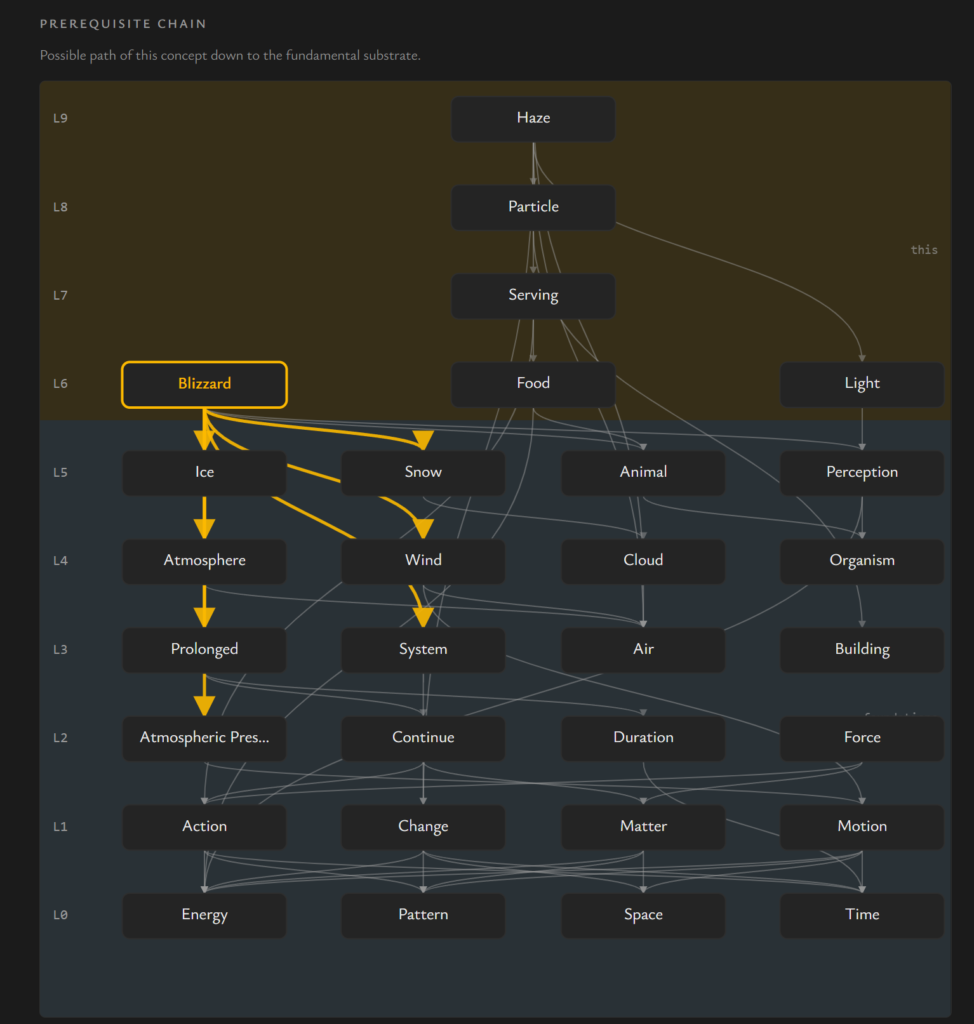
Every word a person uses sits on something, has relations to something in their head. Blizzard sits on snow, ice, wind, atmosphere — and underneath those, on pressure, system, prolonged duration — and underneath those, on energy, pattern, space, time. The word names a thing in the world. The word also names a path down through everything that had to exist for the thing to be possible at all. Most of that path runs invisibly under daily speech. We say the word and the meaning lands. The substrate underneath does not announce itself.
What if you could see the land and see the roads? What if every word you used came with its prerequisite chain visible — the path it takes from your mind down to the floor of reality?
a Lexicon Atlas that maps words, so that the conduit we use to see reality becomes — at least partially, in some abstraction — become visible.
Try for yourself,
Lexicon Atlas
— Sail