

 Trace. Question. Emerge.
Here’s what most people miss: emergence doesn’t just happen. It survives—or it doesn’t.
The universe is littered with emergences that no longer exist. Species that went extinct. Languages no one speaks. Companies that failed. Ideas that were forgotten. Technologies that were replaced.
What determines which emergences survive?
Competition.
But not the kind you learned about in economics class. Not just “companies compete for customers” or “species compete for food.” Something deeper. Something that operates the same way whether you’re looking at immune systems, startup ecosystems, or civilizations.
A virus competing with my immune system isn’t playing the same game as two CEOs competing for market share. Two trading algorithms fighting for arbitrage opportunities isn’t the same competition as two religions fighting for believers. The word “competition” hides a vast landscape of different dynamics.
Different competitors model reality at different depths. And the depth determines everything—what strategies are possible, what timescales matter, what winning even means.
I want to show you the map I’ve found.
Emergence in 60 Seconds.
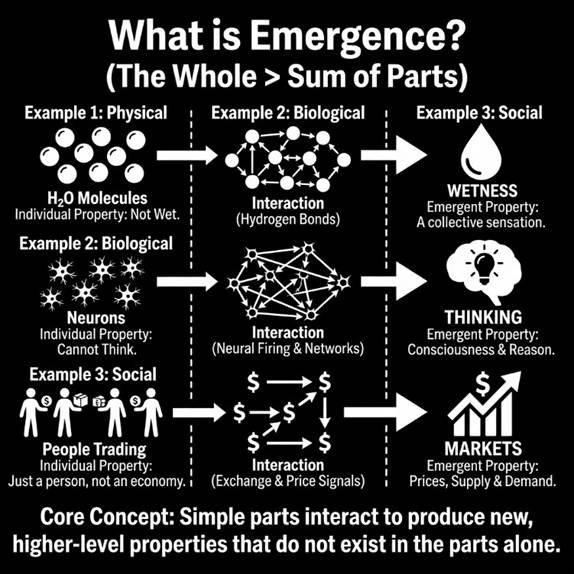
Emergence is when interacting parts produce something none of them possess alone—wetness from molecules, life from chemistry. Ideas work this way: no single neuron or memory contains a thought, but their interaction crystallizes concepts that then reshape the world. Your thoughts are patterns emerging from biology that go on to cause new patterns in other minds and in matter itself.
The emergences that persist do specific things. They maintain the conditions they need—my body maintains temperature, pH, hydration; a company maintains cash flow, talent, customer relationships; a language maintains speakers, contexts of use, transmission to children; an idea maintains relevance, hosts who remember and share it, contexts where it proves useful. They acquire tools that help them persist. They adapt when conditions change.
And they compete. Not just “fighting”—any situation where multiple emergences need the same limited resources. Energy, attention, space, materials, believers, users, habitats. The emergence that gets the resources persists. The one that doesn’t fades back into parts.
But different emergences compete in fundamentally different ways. This post introduces that framework.
The Problem With “Competition”
Here’s what the standard view misses.
When we say “competition,” we usually imagine two similar things fighting for the same prize. Coke vs. Pepsi. Lions vs. hyenas. Democrats vs. Republicans.
Symmetric competition. Same game, same rules, may the best player win.
But most competition isn’t like that.
A virus competes with your immune system—but they’re not playing the same game. The virus can’t “strategize.” Your immune system can’t “evolve” in real-time. They operate by completely different rules.
A startup competes with an enterprise—but they’re not the same kind of thing. The startup can pivot in a week. The enterprise takes months to approve a meeting about potentially considering a change.
A new idea competes with established orthodoxy—but they don’t compete through the same mechanisms. The idea needs to spread mind-to-mind. The orthodoxy has institutions, credentials, and inertia.
Different competitors operate at different levels.
And the level determines the rules of the game.
The Six Classes
I’ve come to see competing systems falling into six classes, distinguished by what they model. Each class sees one layer deeper than the class below it. Each operates by different rules.
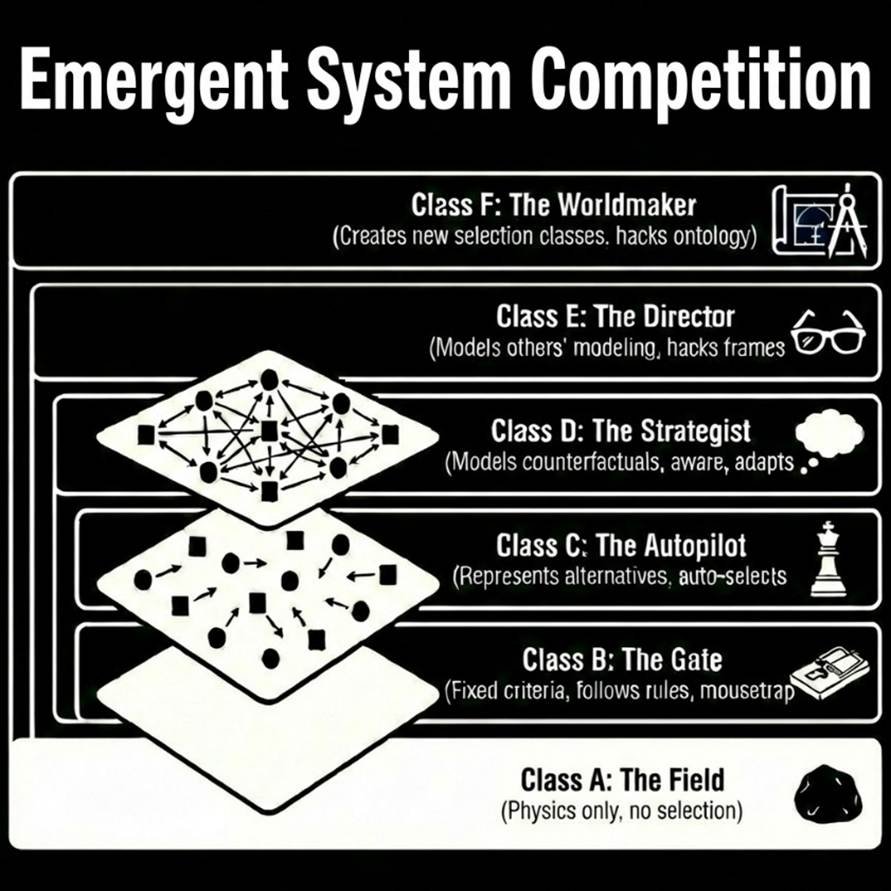
Class A- The Field
Not a competitor. The arena.
Fields are the substrate—the deepest layer, set at the Big Bang and unchanged since. The fundamental forces. The constants. The laws that everything else must obey.
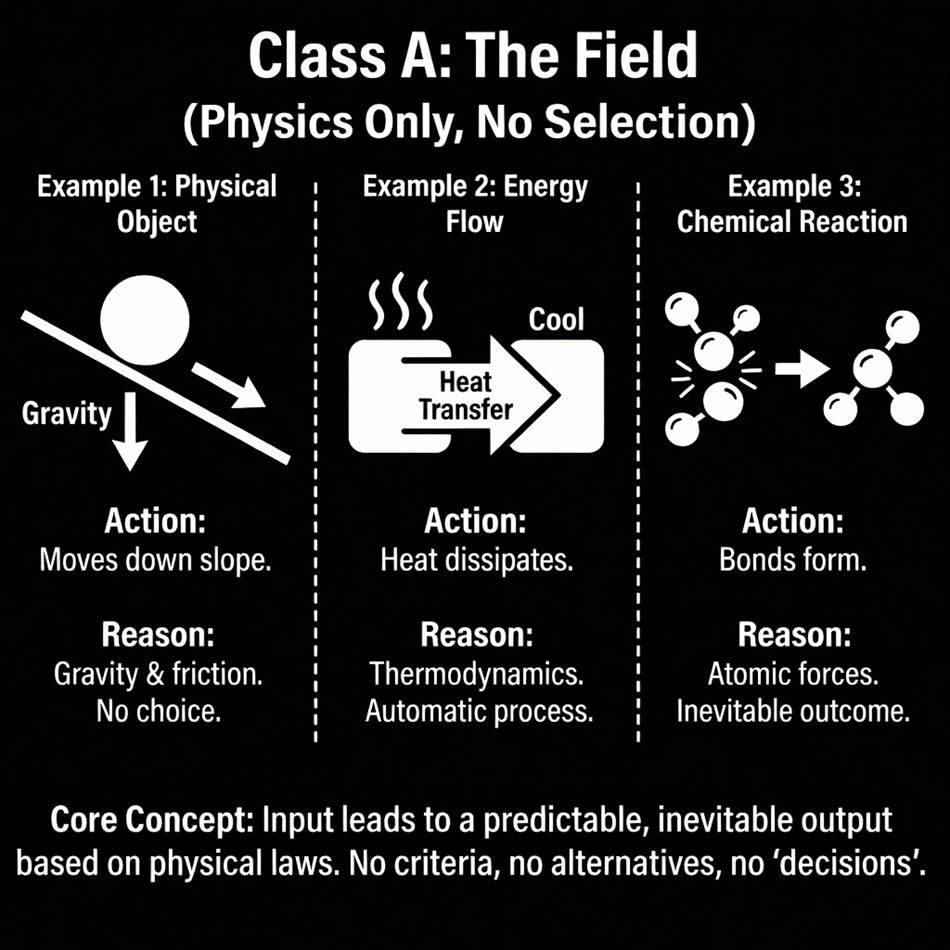
Rivers flowing downhill. Heat dissipating into cold. Light reflecting off surfaces. Chemical reactions proceeding to equilibrium. These aren’t choices. They’re physics resolving.
No criteria. No selection. No alternatives considered. Just the universe doing what it must.
You don’t compete with a Field. You operate inside it. Gravity isn’t my opponent—it’s the terrain. I can use it, work within it, build structures that account for it. But I can’t persuade it, outstrategize it, or defeat it. The rules were written 13.8 billion years ago, and they’re not negotiable.
Class B – The gates
Models thresholds. Fixed criteria, fixed response.
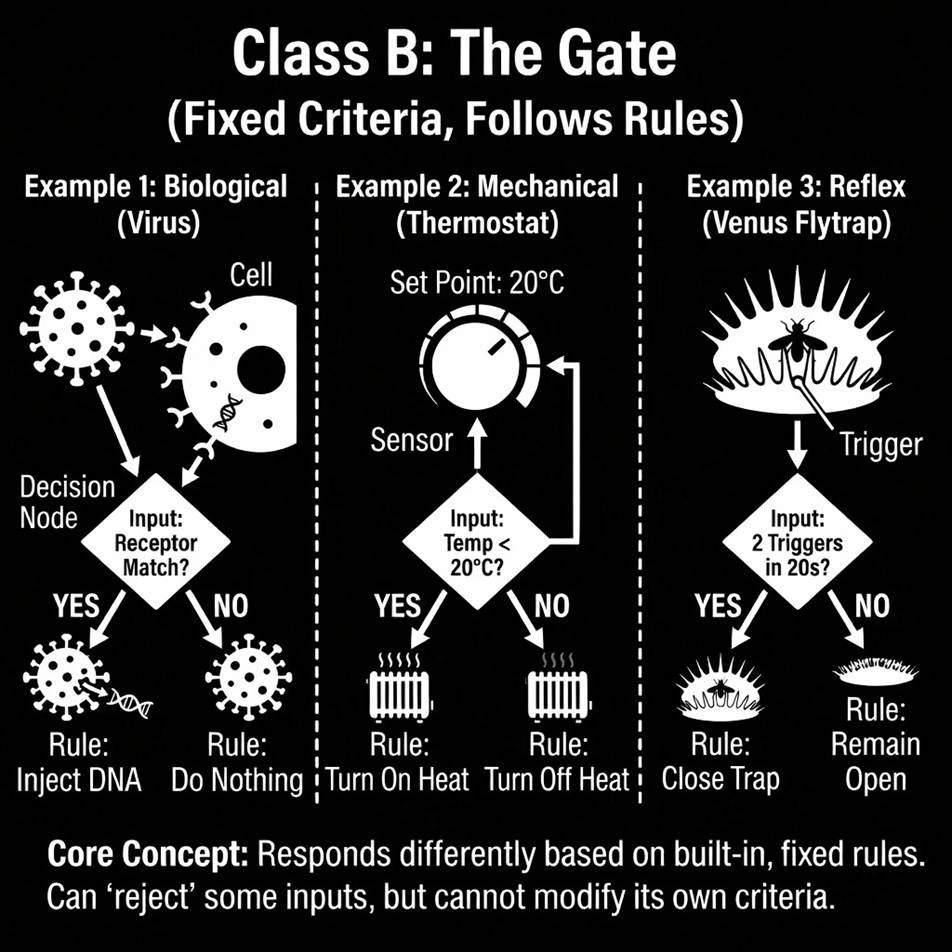
Gates have rules: if X, then Y. Some inputs pass; others don’t. But the gate can’t change its own rules, can’t consider alternatives, can’t reflect on what it’s doing.
A thermostat is a gate—temperature crosses a threshold and the heat turns on. A venus flytrap is a gate—touch the trigger twice in twenty seconds and it snaps shut. An immune cell is a gate—surface marker matches “enemy” pattern and it attacks. A virus is a gate—receptor fits and it attaches.
How Class B competes:
When two Class B systems compete, neither can model the other. Competition becomes co-evolution through blind variation.
Thorns vs tough mouths — Plants with thorns get eaten less. Animals with tougher mouths eat thorny plants. Thorns get sharper. Mouths get tougher. Neither knows why.
Neither side models. Neither side strategizes. Evolution does the work through generations of blind variation and selection.
CLASS C-The Autopilot
Models the world. Doesn’t model itself modeling.
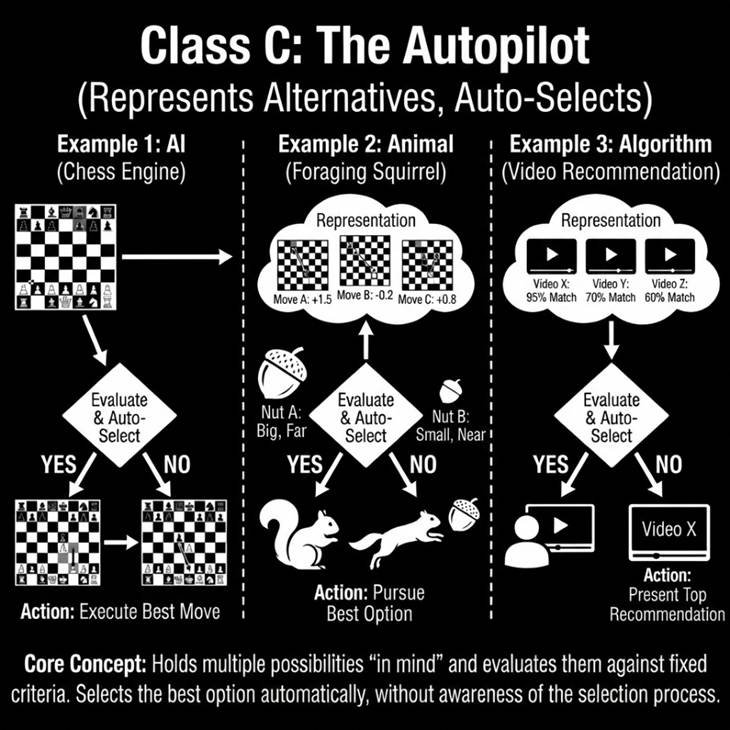
Here’s where representation enters the picture.
Autopilots hold a model of their environment. They represent options, evaluate them against criteria, and select. But they don’t know they’re doing this. There’s processing but no awareness of processing.
The distinction from gates matters: a gate responds to thresholds. An autopilot represents the territory.
A chess engine “knows” the board state—it holds a representation of piece positions, legal moves, and possible futures. It searches that representation and evaluates paths. But the chess engine doesn’t know it’s playing chess. There’s a model of the board, but no model of itself. A recommendation algorithm (represents content options, selects based on engagement prediction)
Most AI systems today are sophisticated autopilots. LLMs, image classifiers, recommendation engines, trading bots—they model the world, optimize impressively, but don’t model themselves modeling. They don’t know they’re choosing.
How Class C competes:
Class C vs. Class B
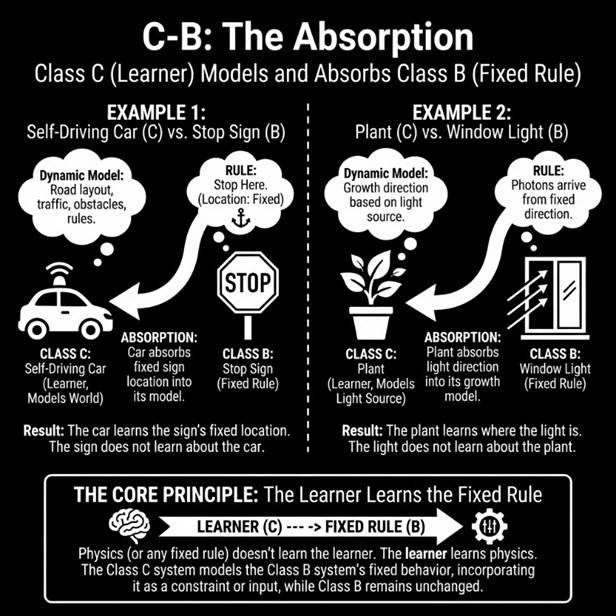
Class C systems can outperform Class B systems because they can represent alternatives and evaluate them before acting. The chess engine considers moves the thermostat can’t imagine.
Class C vs. Class C
But Class C vs. Class C competition is still largely automatic. Both systems run their representations, apply their evaluation functions, and act. Faster processing and better evaluation functions win—not strategic insight.
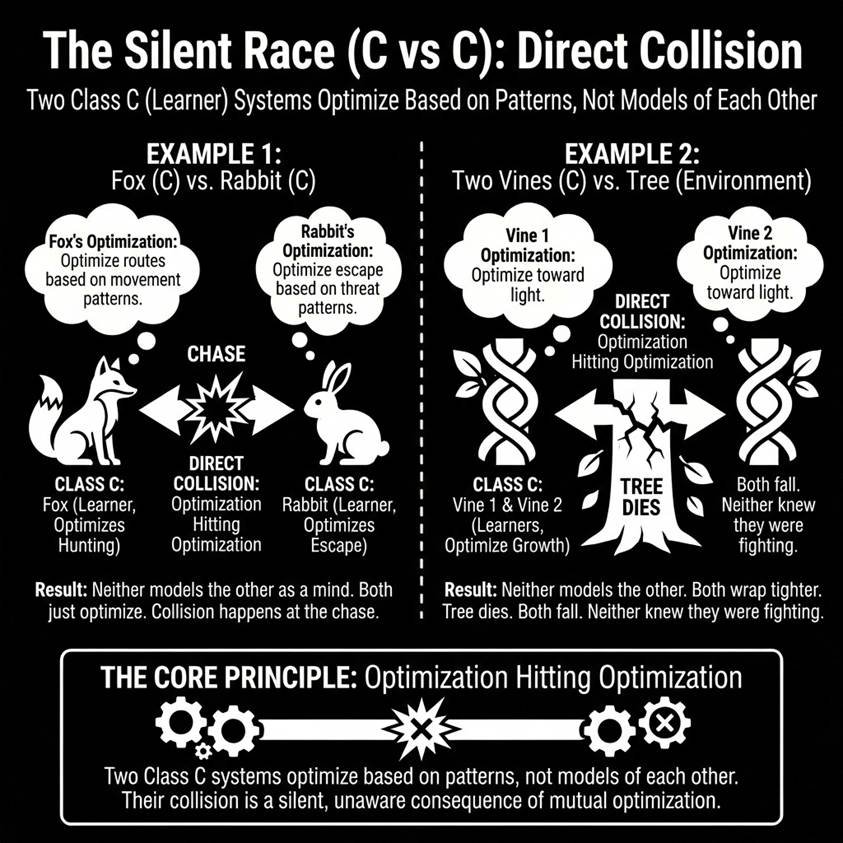
Two trading algorithms competing in a market. Both represent prices, volumes, patterns. Both evaluate based on profit prediction. Both execute automatically. The better model wins, but neither “knows” it’s competing.
CLASS D- The Strategist
Models itself modeling the world. Knows it’s choosing.
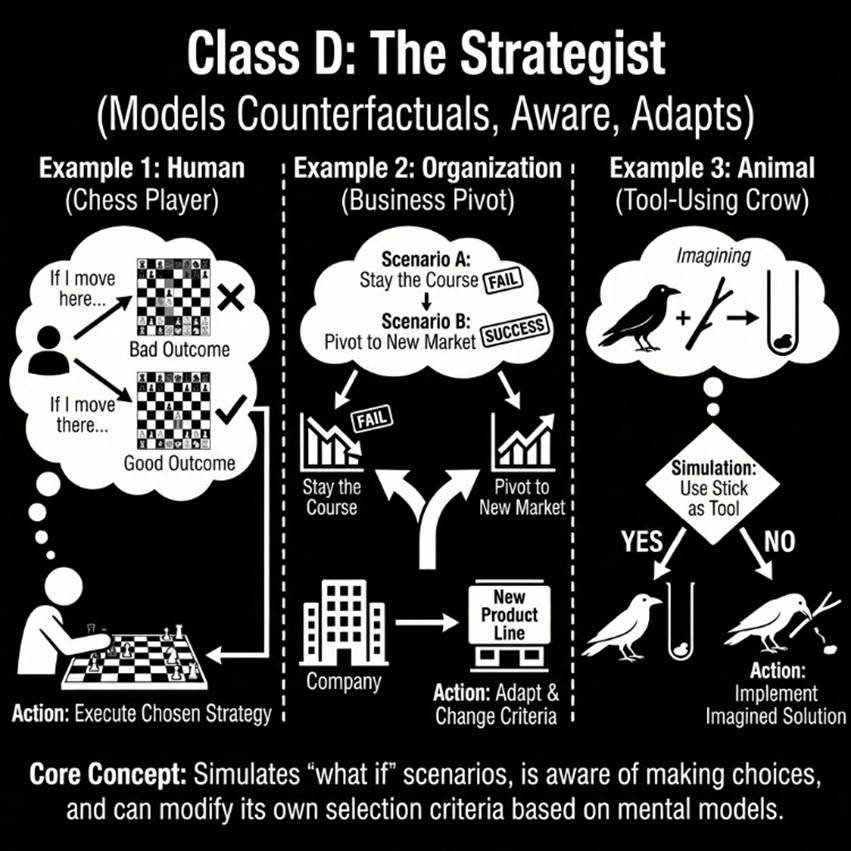
This is where it gets interesting.
Strategists don’t just model the world—they model themselves as modelers. They can observe their own reasoning, question their own criteria, simulate futures, and modify their selection approach based on what they learn. This reflexivity is the key distinction: not just responding to the environment, but watching yourself respond and adjusting the responder.
An autopilot follows its evaluation function. A strategist can ask: Where did this evaluation function come from? Should I trust it?
The C-D boundary — The live question
This is where the AI debate actually is. Is AI crossing from Autopilot to Strategist? Do advanced LLMs model themselves modeling? When Claude considers “how might the user interpret this response,” is that Class D recursion or very sophisticated Class C pattern-matching?
How Class D competes:
Class D vs Class C:
This is gaming the algorithm.
The Autopilot (C) optimizes but can’t model the Strategist(D) as an adversary. It doesn’t know it’s being gamed.
SEO experts(D) vs search algorithms (C). Content creators(D) vs recommendation systems (C). Traders(D) vs trading bots (C). Adversarial attacks on ML classifiers. In each case, the Strategist studies the optimization function and crafts inputs to exploit it. The Autopilot just keeps optimizing against whatever arrives.
The exception: C can beat D through sheer speed and scale in narrow domains. A chess engine beats humans not by out-modeling them as minds, but by out-calculating them as position-evaluators. D’s metacognitive capacity doesn’t matter if the game is purely computational.
Class D vs. Class D
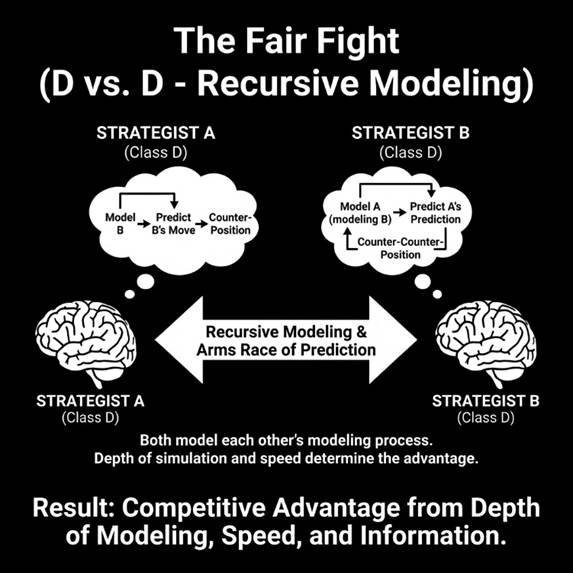
The competition is recursive modeling—I model you modeling me modeling you.
This is game theory territory. Poker. Negotiation. Military strategy. Business competition. SWOT Analysis. Political campaigns.
Each side tries to predict what the other will do, knowing the other is trying to predict them. Depth of modeling matters. Speed of adaptation matters. Quality of information matters.
CLASS E-The Director
Models how others model. Shapes the modeling process itself.
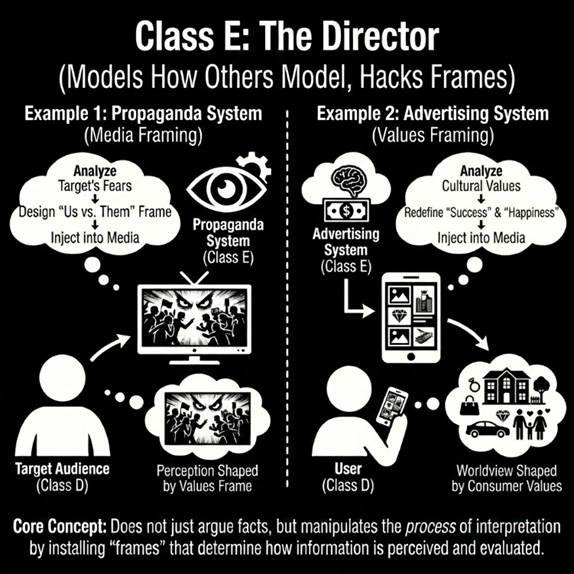
Directors don’t just model the world, and they don’t just model what other strategists might do. They model how others model—the process by which others construct their understanding. And they can intervene in that process.
The strategist asks: “What will they do? How should I respond?”
The director asks: “How are they deciding what to do? What shapes that process?”
They install frames that shape interpretation, direct attention toward some things and away from others, modify the criteria by which you evaluate options. They operate on the modeling process itself, not just its inputs.
Examples: education systems that (ideally) don’t just transmit facts but teach how to think; long-term institutional influence that gradually shifts the frames through which societies interpret events. On the darker side: sophisticated propaganda systems that don’t just lie but reshape what counts as credible.
How Class E competes
Class E vs. Class D
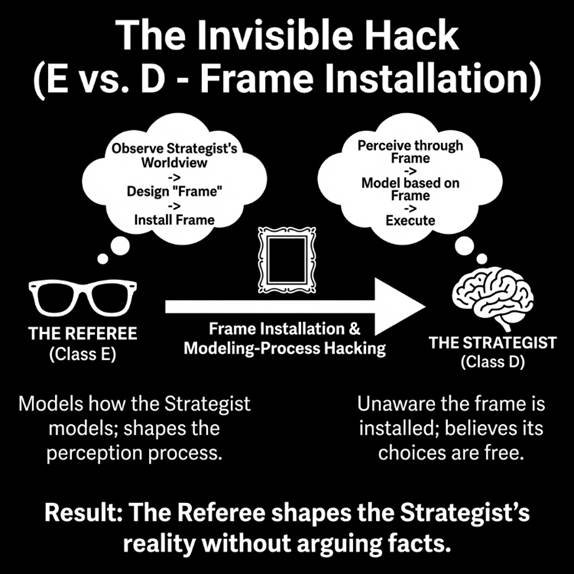
This is asymmetric in E’s favor.
The Strategist(D) thinks it’s making free choices. The Director(E) has shaped what options the Strategist perceives, what criteria it uses to evaluate them, and what information it has access to.
A Class D attack on your political beliefs: “Here’s evidence that your candidate is bad. Here’s an argument for my candidate.”
A Class E attack on your political beliefs: Shapes your media environment so you only see certain information. Installs frames so you interpret new information in a particular way. Associates certain ideas with identity so that questioning them feels like self-betrayal. Makes certain thoughts feel unthinkable.
You still feel like you’re freely reasoning. But the reasoning process itself has been shaped.
A Class D approach to mentorship: “Here’s how I solved this problem. Here’s the strategy you should use.”
A Class E approach to mentorship: Asks questions that reveal your assumptions. Creates situations where you discover your own blind spots. Installs the habit of stress-testing your own plans. Makes “what am I missing?” feel like the natural next thought. Shapes the process so you become someone who notices what you weren’t noticing—not dependent on the mentor, but transformed by having worked with them.
The goal isn’t to give you better answers. It’s to make you a better asker.
The hard part: You can’t step outside all frames. You can only become aware of frames and choose between them. This is why E vs. D is so asymmetric—D can never fully escape E’s influence through D-level methods.
Class E vs Class E
This is the frame war.
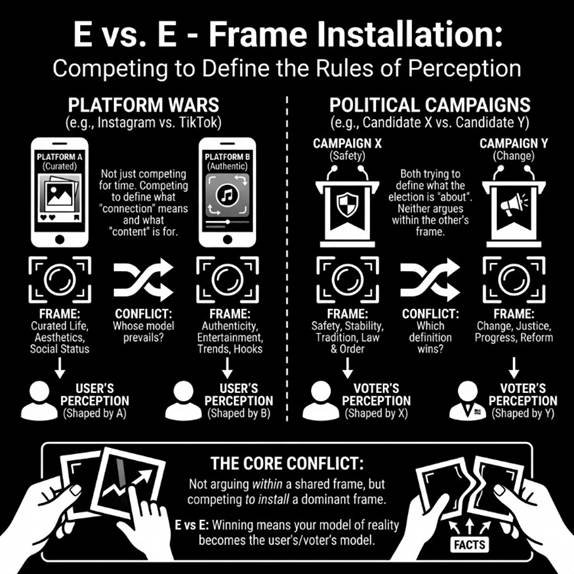
E vs E is rarely direct combat. It’s parallel construction. Each side is building a frame, installing it in as many minds as possible, competing for the same population’s modeling process. The winner is whoever gets their frame to feel like “just how things are.”
Competing platforms shaping what “staying informed” means. Rival political operations each trying to define what questions matter, what sources are credible, what counts as evidence. Institutional battles over who controls the curriculum, the editorial standards, the professional norms.
The fight isn’t over answers. It’s over what the questions are.
Defense against Class E:
Class D defenses—counterargument, better evidence—don’t work well against Class E attacks. The Class E attack has already shaped how you evaluate arguments and evidence. D cannot escape E’s influence through Class D methods alone.
Effective defense is Class E awareness: recognizing that your frames were installed, that your attention was shaped, that your criteria were influenced. This is meta-cognition—thinking about how you think. The question isn’t just “is this true?” but “why does this feel obviously true to me? Who benefits from me seeing it this way? What am I not noticing?”
CLASS F-The Worldmaker
Models what’s real. Defines the categories of existence.
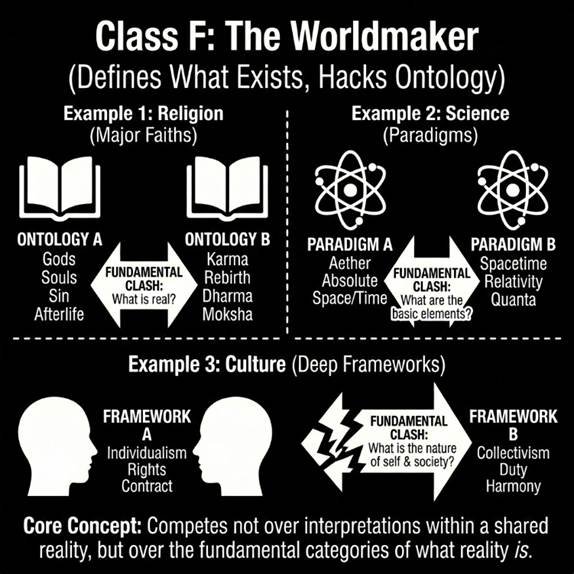
Worldmakers don’t shape how you interpret reality within existing categories. They define what categories exist.
Directors(E) install frames—ways of interpreting things. Worldmakers(F) define ontologies—what kinds of things there are to interpret.
Major religions operate at this level—they define gods, souls, sin, salvation. Scientific paradigms do too—they define matter, energy, natural laws, causation. Constitutional orders define rights, citizenship, legitimate authority. Deep cultural frameworks define self, other, nature, society.
This is why some disagreements feel unresolvable. It’s not that one side has better arguments. They’re not playing the same game. What counts as a “good argument” is itself part of what’s being contested.
How Class F competes
Class F vs Class E
This is framing within a world someone else built.
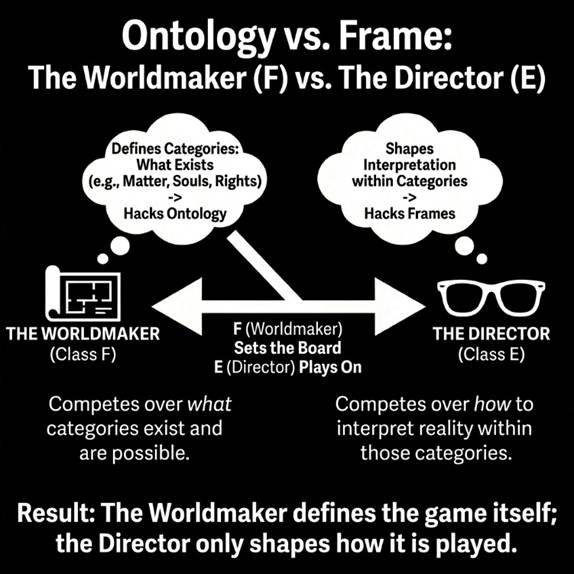
The Director(E) shapes how people interpret—but interprets within categories the Worldmaker(F) defined. The Director works the angles of a game whose rules were set elsewhere.
A political operative reframing a debate (E) is operating inside a constitutional order that defines what “rights,” “citizens,” and “legitimate authority” even mean (F). A therapist installing healthier cognitive frames (E) is working within a psychological paradigm that defines what “self,” “healing,” and “disorder” are (F).
The Director can be extraordinarily effective—and never touch the ontology. They can win every frame battle and still be playing in someone else’s world.
When a Director faces a Worldmaker, the asymmetry is subtle but total. The Director says “let me show you another way to see this.” The Worldmaker says “let me show you what this is.”
The Director can reframe “tax” as “investment” or “theft.” The Worldmaker decides whether “property” is a real thing that can be taken in the first place.
You can win every D-E battle and lose the F-war—if your opponent is redefining what exists.
Class F vs Class F
This is reality against reality.
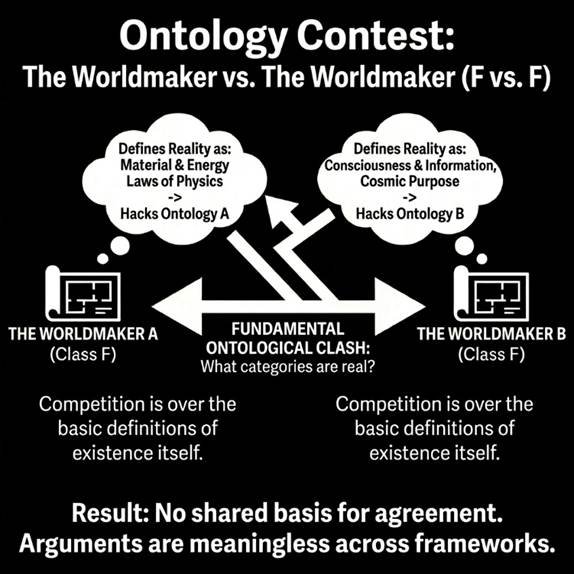
Not a debate. Not a reframe. Two incompatible accounts of what exists, what matters, what’s possible.
Scientific materialism vs religious cosmology. Enlightenment liberalism vs divine-right monarchy. Indigenous worldviews vs colonial ontologies. Each defines different categories of existence. Different things are real in each world.
These don’t resolve through argument—because what counts as a valid argument is itself part of the ontology being contested. Evidence doesn’t settle it—because what counts as evidence is what’s at stake.
How do they resolve?
Slowly. Through which world works better for its inhabitants. Through which world captures more children, more institutions, more territory. Through which world survives contact with a changing environment. Sometimes through which world survives contact with the other’s armies.
Most people never choose a worldview. They inherit one. F vs F competition happens above their heads, across generations, in the slow drift of what seems obviously true.
Multi-Class Systems
Most real systems don’t occupy a single class. A corporation contains Class B compliance rules, Class C optimization algorithms, Class D strategic executives, and Class E narrative operations—all simultaneously. A human being operates across multiple classes depending on which cognitive process you’re examining.
How these layers interact—reinforcing, undermining, creating vulnerabilities—is where the framework gets interesting. That exploration comes later.
Seeing Clearly
I’m not giving you facts about competition. I’m offering you categories. A way of carving up the world. Before this post, you parsed competition however you parsed it. Now you have another option—six classes, defined by what they model, arranged in a hierarchy of depth.
If these categories stick, they’ll shape how you see everything that competes. Including the ideas competing for your attention right now. Including this one.
That’s what Worldmakers do. They don’t win arguments. They change what the arguments are about. The hierarchy isn’t about superiority. It’s about seeing clearly what kind of game is actually being played.
See the class. See the game. Play accordingly.
What’s Next
This is the first part of foundation—the emergence framework itself. The applications come next.
-Sail